

Multi-Function Rheometer (MFR)
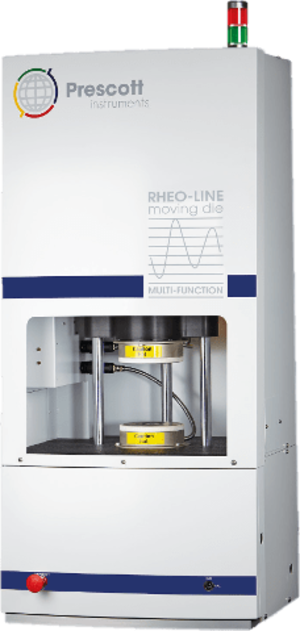
Rheoline MFR – Multi-Function Rheometer by Prescott Instruments
Innovative. Versatile. Exceptionally Precise.
The Rheoline Multi-Function Rheometer (MFR) by Prescott Instruments is an advanced dynamic testing instrument designed to deliver highly accurate, reliable and reproducible results across a wide range of test stages and operating conditions. Combining the capabilities of a Moving Die Rheometer (MDR) and a Dynamic Shear Rheometer (DSR), the MFR provides detailed analytical and statistical data on the properties of elastomers, making it an ideal solution for demanding polymer testing applications.
One of the key advantages of the Rheoline MFR is its ability to characterize rubber compounds before, during and after vulcanization. By varying temperature, frequency and strain, the instrument enables comprehensive investigation of polymer processing behavior, curing characteristics and the dynamic mechanical properties of cured materials.
The MFR incorporates a new-generation in-line servo motor with advanced digital servo drive technology, combined with Prescott Instruments’ powerful Labline data acquisition and analysis software. Its exceptional flexibility supports a wide range of test conditions and unlimited user-defined test methods.
Advanced temperature control maintains temperature variation within an impressive ±0.03°C of the set point, ensuring excellent stability and repeatability. An integrated air cooling system is included as standard, supporting efficient temperature sweep testing.
Key Benefits
🟢 Multi-Functional Testing – Combines the capabilities of an MDR and DSR in a single instrument
🟢 Comprehensive Material Characterization – Investigates elastomer properties before, during and after vulcanization
🟢 Exceptional Temperature Control – Maintains temperature variation within ±0.03°C of the set point
🟢 Advanced Servo Motor Technology – Delivers precise drive control and reliable measurement performance
🟢 Flexible Labline Software – Supports unlimited test methods and customizable test configurations
🟢 Integrated Air Cooling System – Enables efficient temperature sweep testing and controlled cooling
🟢 Excellent Repeatability – Provides stable and reproducible results for demanding testing applications
Modes of Operation
The Rheoline MFR features a range of pre-programmed tests while offering complete flexibility to configure individual test stages. Users can define custom test procedures using any operating mode, either individually or in combination through the Linked Test function.
Available Test Modes
- Frequency Sweep – Evaluates material behavior across a range of oscillation frequencies
- Strain Sweep – Investigates the influence of deformation amplitude on material properties
- Temperature Sweep – Examines temperature-dependent material behavior, supported by forced cooling
- Standard MDR Mode – Performs conventional rubber curing and vulcanization tests
- Pre-Set Test Specifications – Provides predefined test procedures for efficient and consistent operation
- Conditioning – Allows samples to be conditioned under defined test conditions
- Combination (Linked) Tests – Combines multiple test stages into one continuous procedure
Linked Testing – Comprehensive Analysis in a Single Test
The Linked Test function enables multiple material properties to be measured efficiently within a single, continuous test sequence. This reduces the need for separate testing procedures and provides a more comprehensive understanding of material behavior throughout the curing process.
A typical linked test sequence includes:
- Pre-Cure Analysis – Strain and frequency sweeps to investigate the uncured compound
- Curing Analysis – A standard MDR test to characterize vulcanization behavior
- Post-Cure Analysis – Strain and frequency sweeps to evaluate the dynamic mechanical properties of the cured material
With its versatile operating modes, advanced servo technology and precise temperature control, the Rheoline MFR provides polymer specialists with a powerful solution for in-depth elastomer characterization, formulation development and process optimization.
Complete Testing Package – Rheoline MFR by Prescott Instruments
Ready to use. Fully equipped. Built for precision.
As part of Prescott Instruments’ commitment to customer satisfaction, the Rheoline Multi-Function Rheometer (MFR) is supplied with everything required to perform dynamic, accurate and efficient elastomeric compound testing.
The supplied PC comes pre-installed and calibrated with Labline software, an advanced data acquisition and analysis suite developed exclusively by Prescott Instruments. The software enables efficient test management, reliable measurement and convenient evaluation of test data.
Package Includes
🟢 Windows® PC System – Microsoft Windows®-based PC, complete with monitor, keyboard and mouse
🟢 Labline Software – Advanced data acquisition and analysis software, pre-installed and calibrated
🟢 Cables and Connectors – All required peripheral cables and connectors for system installation and operation
🟢 Essential Spares Package – A selection of essential spare parts to support routine operation and maintenance
🟢 One Year of Free Technical Support – Professional technical assistance from Prescott Instruments for added confidence and reliable operation
With this comprehensive package, the Rheoline MFR provides a fully equipped solution for precise and reproducible elastomer testing from day one.
Labline LIMS – Advanced Testing Software for the Rheoline MFR by Prescott Instruments
Intelligent. Flexible. Precise.
The Rheoline Multi-Function Rheometer (MFR) is supplied with the latest computer hardware and Labline LIMS, an innovative data acquisition and analysis software package developed exclusively by Prescott Instruments for Microsoft Windows®.
Labline LIMS supports an unlimited number of test specifications, each with any number of test points, providing maximum flexibility for a wide range of testing requirements. An integrated calibration module helps ensure accurate measurements and reliable data acquisition.
Key Features
🟢 Automatic Pass/Fail Evaluation – Automatically assesses test results against predefined acceptance criteria
🟢 Laboratory Statistics – Supports comprehensive analysis and evaluation of laboratory data
🟢 Multilingual Interface – Enables convenient operation in multiple languages
🟢 Simple Instrument and Test Configuration – Simplifies instrument setup and the definition of individual test parameters
🟢 Preloaded Test Specifications – Provides predefined test procedures for efficient testing
🟢 Trend Charts – Visualizes measurement trends to help identify changes in material properties and process performance
🟢 Easy Result Recalculation – Allows existing test data to be recalculated when required
🟢 Report Printing Capabilities – Simplifies the documentation and presentation of test results
🟢 ODBC Database Connectivity – Supports connections to external databases, including:
- Microsoft Access®
With Labline LIMS, Prescott Instruments provides a powerful software solution for efficient test management, reliable data analysis and comprehensive quality assurance in elastomer and polymer testing.
Labline LIMS – Test Methods, Test Points, Measurement Channels and Units
Versatile. Precise. Powerful.
Labline software for the Rheoline Multi-Function Rheometer (MFR) by Prescott Instruments offers an extensive range of test methods, test points and measurement channels for the detailed characterization of elastomers and rubber compounds. Flexible test configurations and customizable test sequences enable comprehensive analysis of material properties before, during and after vulcanization.
All test methods support an unlimited number of data points across all measurement channel curves, allowing detailed evaluation of material behavior throughout the testing process.
Test Methods
- Standard Cure (MDR Mode, Non-Isothermal) – Evaluates curing behavior under non-isothermal conditions
- Strain Sweep (LAOS) – Analyzes nonlinear material behavior at varying strain amplitudes
- Payne Test – Investigates strain-dependent viscoelastic behavior, particularly in filled elastomers
- Stress Relaxation – Analyzes stress reduction under defined test conditions
- Frequency Sweep – Evaluates material behavior across different test frequencies
- Conditioning – Prepares samples under defined conditions
- Linked Test – Combines any selection of test methods with individually defined durations into a single continuous test sequence
Test Points
Labline LIMS provides an extensive range of test points for detailed evaluation of curing behavior and dynamic material properties.
| Test Parameter | Test Parameter |
|---|---|
| Minimum (ML) | Maximum (MH) |
| Initial | Final |
| Scorch (TS) | Cure Percentage |
| Minimum (True) | Maximum (True) |
| Time Gate | Cure Gate |
| Reversion | Cure Rate |
| Cure Rate Time | Cure Rate Value |
| Delta Cure | Delta Cure Time |
| Max. Percentage | Frequency Gate |
| Frequency Gate (Rev) | Strain Gate |
| Strain Gate (Rev) | Temperature Gate |
| Temperature Gate (Rev) |
Measurement Channels
The software supports a wide range of measurement channels for comprehensive analysis of rheological and dynamic mechanical material properties.
- Elastic Torque – Elastic response of the material
- Viscous Torque – Viscous response of the material
- Tangent Delta – Loss factor
- Cure Rate – Rate of vulcanization
- Temperature (Upper) – Upper die temperature
- Temperature (Lower) – Lower die temperature
- Pressure in Cavity – Pressure within the test cavity, supplied as standard
- Complex Torque – Complex torque
- Loss Angle – Phase loss angle
- Storage Modulus – Elastic energy storage component
- Loss Modulus – Energy dissipation component
- Complex Modulus – Combined viscoelastic modulus
- Storage Compliance – Storage compliance
- Loss Compliance – Loss compliance
- Complex Compliance – Complex compliance
- Real Dynamic Viscosity – Real component of dynamic viscosity
- Imaginary Dynamic Viscosity – Imaginary component of dynamic viscosity
- Dynamic Complex Viscosity – Complex dynamic viscosity
Units of Measurement
Labline LIMS supports multiple units of measurement to accommodate different testing requirements and evaluation standards.
| Measurement | Available Units |
|---|---|
| Time | Seconds (s), minutes:seconds (min:sec), decimal minutes (min.dec) |
| Temperature | °C, °F |
| Torque | dNm, in·lbf, kg·cm |
| Pressure | kPa, lb/in², kg/cm² |
| Cure Rate | in·lbf/s, dNm/min, in·lbf/min, dNm/s |
| Angle | Degrees (°), radians (rad) |
| Frequency | Hz, CPM (cycles per minute), rad/s |
| Strain | %, rad (angular measure) |
| Modulus | kPa |
| Compliance | 1/MPa |
| Dynamic Viscosity | kPa·s |
With its combination of versatile test methods, extensive measurement channels and flexible data analysis capabilities, Labline LIMS provides a powerful platform for the detailed characterization of elastomers and rubber compounds – from the analysis of uncured compounds to the evaluation of vulcanized materials.
Dynamic Material Properties – Rheoline MFR by Prescott Instruments
Precise. Analytical. Comprehensive.
The dynamic properties of an elastomer are best investigated by measuring its response to an applied sinusoidal deformation. The Rheoline Multi-Function Rheometer (MFR) by Prescott Instruments operates as a Dynamic Shear Rheometer (DSR), applying shear deformation to the sample through small-amplitude angular oscillations.
The resulting torque is analyzed and separated into two distinct components: the elastic response and the viscous response. These components provide valuable insights into the viscoelastic behavior of the material.
The elastic component is associated with the in-phase stress response, while the viscous component represents the out-of-phase response. The phase difference between the applied strain and the resulting stress response is known as the phase angle or loss angle (δ). A more viscous material generally exhibits a larger loss angle.
The tangent of this angle, tan δ, represents the ratio of the loss modulus to the storage modulus. It is an important indicator of the balance between the elastic and viscous behavior of an elastomer.
Dynamic Measurement Parameters
Torque Parameters
Elastic Torque (S′)
The peak-amplitude torque component that is in phase with the applied sinusoidal strain. It represents the elastic response of the material.
Viscous Torque (S″)
The peak-amplitude torque component that is 90° out of phase with the applied sinusoidal strain. It represents the viscous response of the material.
Complex Torque (S*)
The resultant peak-amplitude torque response measured by the reaction torque transducer during sinusoidal deformation. It combines the elastic and viscous torque components.
S∗=(S′)2+(S′′)2
Modulus Parameters
Storage Shear Modulus (G′)
The ratio of the peak-amplitude elastic shear stress to the peak-amplitude shear strain. It describes the material's ability to store elastic energy during deformation.
G′=(S′/A)γ0
Loss Shear Modulus (G″)
The ratio of the peak-amplitude viscous shear stress to the peak-amplitude shear strain. It describes the energy dissipated by the material during deformation.
G′′=(S′′/A)γ0
Complex Shear Modulus (G*)
The ratio of the peak-amplitude shear stress to the peak-amplitude shear strain, combining the storage and loss moduli into a single measure of the material's overall dynamic stiffness.
G∗=(G′)2+(G′′)2
Where A is the effective sample area and γ₀ is the peak shear strain.
Phase and Loss Parameters
Loss Angle (δ)
The phase angle by which the complex torque response leads the applied sinusoidal strain. It characterizes the phase difference between the elastic and viscous responses.
Loss Factor (tan δ)
The ratio of the loss modulus to the storage modulus, or equivalently the ratio of viscous torque to elastic torque.
tanδ=G′′G′=S′′S′
A lower tan δ generally indicates more elastic behavior, while a higher tan δ indicates a greater contribution from viscous behavior.
Dynamic Viscosity Parameters
Dynamic Complex Viscosity (η*)
The magnitude of the complex dynamic viscosity, calculated as the complex shear modulus divided by the angular oscillation frequency.
η∗=∣G∗∣ω
Real Dynamic Viscosity (η′)
The real component of the complex dynamic viscosity, related to the loss shear modulus and the angular oscillation frequency.
η′=G′′ω
Here, ω represents the angular frequency in radians per second.
Comprehensive Viscoelastic Characterization
By measuring and evaluating these parameters, the Rheoline MFR enables detailed characterization of the viscoelastic properties of elastomers and rubber compounds. The results help polymer specialists understand the balance between elastic energy storage and viscous energy dissipation, supporting material development, formulation optimization and quality assurance.
The combination of advanced dynamic testing capabilities and flexible Labline software makes the Rheoline MFR a powerful solution for investigating complex material behavior under precisely controlled test conditions.
Technical Specifications – Rheoline MFR by Prescott Instruments
Precise. Versatile. Powerful.
The Rheoline Multi-Function Rheometer (MFR) by Prescott Instruments is designed for demanding dynamic testing of elastomers and rubber compounds. With a wide frequency and amplitude range, precise temperature control and flexible test parameters, the system enables comprehensive characterization of material behavior before, during and after vulcanization.
Standards Compliance
The Rheoline MFR conforms to the following testing standards:
- ISO 6502 / ISO 13145
- ASTM D5289 / ASTM D6048 / ASTM D6204
- ASTM D6601 / ASTM D7605 / ASTM D7050
- ASTM D8059
- DIN 53529
Technical Data
| Parameter | Specification |
|---|---|
| Die System | Rotorless, biconical, sealed system |
| Die Gap | 0.45 mm nominal |
| Oscillation Frequency | 0.001 Hz to 50 Hz |
| Oscillation Amplitude | ±0.001° to 360° |
| Temperature Range | Ambient temperature to 250°C |
| Maximum Heating Rate | 80°C/min |
| Cooling Rate | Forced air cooling: 20°C/min |
| Temperature Control | Three-term PID control; accuracy up to ±0.03°C |
| Torque Measurement | Reaction transducer in the upper platen |
| Torque Range | 0.001 to 250 dNm |
| Cavity Volume | 4.5 cm³ |
| Cavity Pressure | 0.001 to 10 kN (as specified by the manufacturer) |
| Calibration System | Torsion spring |
| Closing System | Soft-closing mechanism to reduce film breakage and sample distortion |
| Drive System | In-line servo motor with digital Aerotech controller |
| Integrated Cooling System | Yes |
| Electrical Supply | Single-phase: 220/240 V, 50 Hz or 110 V, 60 Hz |
| Power Consumption | 350 VA |
| Pneumatic Supply | Filtered air, minimum 0.41 MPa / 60 psi / 4.14 bar / approx. 4.2 kgf/cm² |
| Weight | 250 kg |
| Dimensions (W × D × H) | 575 × 570 × 1,280 mm |
Key Performance Features
- Wide Frequency Range – Dynamic material testing from 0.001 Hz to 50 Hz
- Flexible Oscillation Amplitude – Adjustable test conditions for investigating different material properties
- Precise Temperature Control – High temperature stability with control accuracy up to ±0.03°C
- Efficient Temperature Management – High heating rates and integrated forced-air cooling for demanding temperature sweep tests
- Advanced Drive Technology – In-line servo motor and digital Aerotech controller for precise motion control
- Gentle Sample Clamping – Soft-closing mechanism designed to minimize sample distortion and film breakage
Note: The supplied specification lists cavity pressure in kN. Since kN is a unit of force rather than pressure, the exact measurement parameter and unit should be verified against the latest manufacturer datasheet. All other technical specifications have been reproduced from the information provided.
Multi-Frequency Calibration ? Rheoline MFR by Prescott Instruments
Accurate. Reliable. Consistent.
At Prescott Instruments, we offer multi-frequency calibration for the Rheoline Multi-Function Rheometer (MFR), ensuring accurate, repeatable and reliable measurement results across the entire operating frequency range.
Rather than verifying instrument performance at a single frequency, multi-frequency calibration evaluates the system at several frequencies to confirm that the complete measurement chain performs as intended under normal operating conditions.
What Does Multi-Frequency Calibration Verify?
Multi-frequency calibration assesses the performance of the key components responsible for accurate measurement:
Motor and Drive System ? Verifies consistent drive performance across different operating frequencies.
Torque Transducer ? Checks the accuracy and reliability of torque measurements.
Signal Processing ? Evaluates the processing of measurement signals to ensure reliable data acquisition.
Mechanical Structure (Chassis) ? Accounts for the influence of mechanical characteristics on measurement performance.
Why Is Multi-Frequency Calibration Important?
A single-frequency calibration confirms that an instrument performs correctly at one specific operating point. However, it does not demonstrate that the same level of accuracy is maintained across the entire frequency range.
Mechanical properties such as stiffness, damping and overall system dynamics can vary with frequency. By verifying instrument performance at multiple points, Prescott Instruments helps ensure that these effects do not compromise measurement accuracy.
This approach confirms that the MFR responds consistently as the test frequency changes, providing greater confidence that measured torque values remain accurate regardless of the selected operating frequency.
Key Benefits
? Accuracy Across the Frequency Range ? Verifies measurement performance at multiple operating frequencies rather than at a single point.
? Reliable and Repeatable Results ? Supports consistent measurement performance across different test conditions.
? Comprehensive System Verification ? Evaluates the complete measurement chain, including the drive system, torque transducer, signal processing and mechanical structure.
? Confidence in Measurement Data ? Helps ensure that results accurately reflect material behavior under real operating conditions.
? Rigorous Instrument Validation ? Provides a more comprehensive assessment of instrument performance than single-frequency calibration alone.
Greater Confidence in Every Measurement
By validating performance across the operating frequency range, multi-frequency calibration provides a more comprehensive verification of the Rheoline MFR. This rigorous approach helps maintain measurement integrity and gives users greater confidence in the consistency, repeatability and reliability of their test results.
With multi-frequency calibration from Prescott Instruments, you can be confident that your Rheoline MFR is assessed beyond a single operating point and verified for demanding dynamic elastomer testing applications.
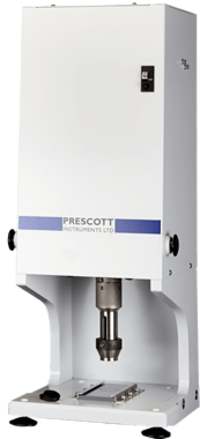
Note: For precise and reproducible test results, sample preparation using the automatic Rheoline Volumetric Sample Cutter (VSC) is strongly recommended. It ensures consistent sample volumes and dimensions when testing with the Rheoline MDR.


