

Plastimeter
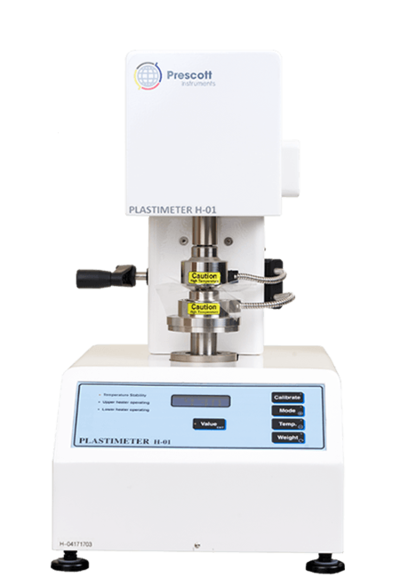
Plastimeter – Plasticity Testing Instrument
Precise. Simple. Reliable.
The Plastimeter is designed to determine the plasticity of natural rubber and evaluate the properties of unvulcanized rubber compounds. It is particularly used to determine the Plasticity Retention Index (PRI), an important indicator of the resistance of raw natural rubber to thermal oxidative degradation.
The test method measures the remaining sample thickness after controlled heating and compression under defined conditions. With a simple, clean and rapid testing procedure, the Plastimeter is ideal for routine quality control in rubber testing laboratories.
Key Features
🟢 Plasticity Measurement – Determines the plasticity or viscosity of unvulcanized rubber.
🟢 PRI Determination – Measures the Plasticity Retention Index of natural rubber to assess its resistance to thermal aging.
🟢 Simple Testing Procedure – A straightforward process with standardized testing conditions.
🟢 Fast Measurements – Efficient testing for routine material quality control.
🟢 Controlled Test Conditions – Defined temperature, time and force parameters support consistent and comparable results.
Mode of Operation
The test uses a circular rubber specimen positioned between an upper and a lower testing plate (dies).
- Sample Preparation – A circular specimen with a diameter of 13 mm and a thickness of 3.2–3.6 mm is prepared.
- Temperature Conditioning – The specimen is placed between the testing plates, which are maintained at 100°C.
- Preheating and Compression – The lower plate moves upwards, compressing the specimen to a thickness of 1 mm. The specimen is then heated for 15 seconds.
- Loading – The upper plate applies a force of 100 N to the specimen for a further 15 seconds.
- Thickness Measurement – The remaining specimen thickness is used to determine the plasticity value.
Plasticity Retention Index (PRI)
The Plasticity Retention Index (PRI) expresses the ratio of the plasticity of natural rubber after controlled heat aging to its plasticity before aging.
For PRI determination, the rubber specimen is heated at 140°C for 30 minutes. Its plasticity is then measured and compared with the original value.
Calculation:
PRI=Pafter agingPbefore aging×100
Where P represents the measured plasticity value.
A higher PRI generally indicates greater resistance of natural rubber to thermal oxidative degradation.
Applications
The Plastimeter is particularly suitable for:
- Natural Rubber Quality Control – Assessing the properties of incoming raw materials.
- PRI Determination – Evaluating resistance to thermal aging.
- Material Characterization – Investigating the plasticity and processing behavior of unvulcanized rubber.
- Incoming Material Inspection – Supporting consistent raw material quality in rubber manufacturing.
The Plastimeter provides a practical solution for standardized plasticity testing and quality assessment of natural rubber.
Complete Testing Package – Plastimeter
Ready to use. Reliable. Efficient.
As part of our commitment to you, the Plastimeter is supplied with the essential accessories required for accurate and efficient elastomeric compound testing.
Package Includes
🟢 Cables and Connectors – All required peripheral cables and connectors.
🟢 Essential Spares Package – A selection of essential spare parts to support routine operation and maintenance.
Software – Plastimeter by Prescott Instruments
Flexible. User-Friendly. Powerful.
The Plastimeter is optionally available with modern computer hardware and Universal Instruments software for Microsoft Windows®. This innovative data acquisition and analysis software is designed to efficiently record, analyze and manage test data while supporting the integration of a wide range of laboratory instruments.
The software offers three methods of data entry and supports custom registration of manual laboratory equipment and instruments that are not configured with Labline software. This makes it an ideal solution for laboratories seeking to centralize their testing workflows and data management.
Optional Software Features
🟢 Automatic Pass/Fail Results – Automatically evaluates test results against predefined acceptance limits.
🟢 Laboratory Statistics – Provides statistical analysis of test data to support quality control.
🟢 Multilingual Interface – Supports multiple languages for convenient operation.
🟢 Simple Instrument and Test Configuration – Enables straightforward setup of instruments and test procedures.
🟢 Preloaded Test Specifications – Provides predefined test configurations for efficient workflows.
🟢 Trend Charts – Visualizes measurement data and trends to help identify changes over time.
🟢 Easy Result Recalculation – Allows existing test results to be recalculated conveniently.
🟢 Report Printing Capabilities – Supports the generation and printing of test reports for documentation and quality assurance.
🟢 ODBC Database Connectivity – Supports connections to external databases, including:
- Microsoft Access®
- Microsoft SQL Server®
- IBM DB2®
Efficient Laboratory Management
With flexible data entry options, comprehensive analysis functions and optional database connectivity, Universal Instruments software supports structured and efficient laboratory management. It enables manual testing equipment and instruments not configured with Labline to be incorporated into digital data collection workflows, helping laboratories maintain consistent documentation and reliable test records.
Technical Specifications – Plastimeter by Prescott Instruments
Technical Data
| Parameter | Specification |
|---|---|
| Standards | ISO 2007, ASTM D3194-99, BS 903: Part A59 |
| Compressive Force | 100 ± 1 N |
| Test Time | 15 ± 0.2 seconds |
| Preheating Time | 15 ± 1 seconds |
| Test Temperature | 100 ± 1°C |
| Temperature Resolution | 0.1°C |
| Fixed Thickness | 1.00 ± 0.01 mm |
| Measurement Resolution | 0.1 / 0.5 units |
| LCD Display | 16 × 2 characters |
| Distance Between Upper and Lower Dies | 25–30 mm |
| Platen Diameters | 7.3, 10.0 and 14.0 mm |
| Dimensions (W × D × H) | 293 × 407 × 540 mm |
| Electrical Supply | AC 220 V ± 10%, 50/60 Hz |
| Power Consumption | 300 W |
| Calibration | Fully automatic calibration |
| Operating Temperature | 15–60°C |
| Operating Humidity | 35–55% RH |
| Drive System | In-line servo motor with Aerotech digital controller |
| Weight | 45 kg |
Key Technical Features
- Standardized Testing – Designed for testing in accordance with the specified international and industry standards.
- Precise Force Control – Compressive force of 100 ± 1 N for consistent testing conditions.
- Accurate Temperature Regulation – Test temperature of 100 ± 1°C with a resolution of 0.1°C.
- Controlled Test Parameters – Precisely defined preheating and testing times.
- Automatic Calibration – Fully automatic calibration for convenient instrument setup.
- Compact Design – Space-efficient construction suitable for laboratory environments.
The Plastimeter combines controlled compression, precise temperature regulation and automatic calibration to support reliable and repeatable plasticity testing of natural rubber.
Note: The original specification lists “ASM D3194-99”; this has been rendered as ASTM D3194-99. Please verify the applicable standard designation with the manufacturer.


